Each organization in the global community of Crossref members (that’s currently over 24k organizations in 166 different countries) plays a key role in building the Research Nexus. Any opportunity we have to meet with our members in person is a highlight and a way for us to learn more from each other. The month of January saw three of us travel to Bangkok to attend the first-ever Charleston Conference organised in Asia and to meet with our growing community in Thailand.
This year, we placed a spotlight on the Latin American community, hosting the second Crossref Metadata Sprint in São Paulo, Brazil from 4 - 6 March 2026. In our first tri-lingual event, we brought together 31 participants from Argentina, Brazil, Colombia, Ecuador, and Mexico. Our goal was to foster community co-creation using the open scholarly metadata. The Sprint was an opportunity to pose questions, share ideas, collaborate on research, and propose innovative solutions that enhance the use of metadata in scholarly communication and beyond.
Read on for more details about the content of the Sprint, and the resulting projects. You can also register to join our Sprint Showcase call on 22nd April to hear directly from the team about their creations.
On 17 March 2026, we experienced an outage that affected DOI resolution for Crossref DOIs and the deposit of metadata records by Crossref members. In this summary, we outline what happened, the impact on our community, and the steps we are taking to strengthen our systems and processes as a result.
We’re excited to announce a new data citation API endpoint and are seeking your feedback. The new service makes existing data citation relationships in our metadata available, thereby surfacing this part of the research nexus. At the same time, we’ve decided that it’s time to move on from Event Data.
Cited-by supports members who display citations, enabling the community to discover connections between research outputs.
Scholars use citations to critique and build on existing research, acknowledging the contributions of others. Members can include references in their metadata deposits which Crossref uses to create links between works that cite each other. The number of citations each work receives is visible to anyone through our public APIs. Through our Cited-by service, members who deposit reference metadata can retrieve everything they need to display citations on their website.
Members who use this service are helping readers to:
easily navigate to related research,
see how the work has been received by the wider community,
explore how ideas evolve over time by highlighting connections between works.
Watch the introductory Cited-by animation in your language:
Cited-by begins with references deposited as part of the metadata records for your content. Learn more about depositing references.
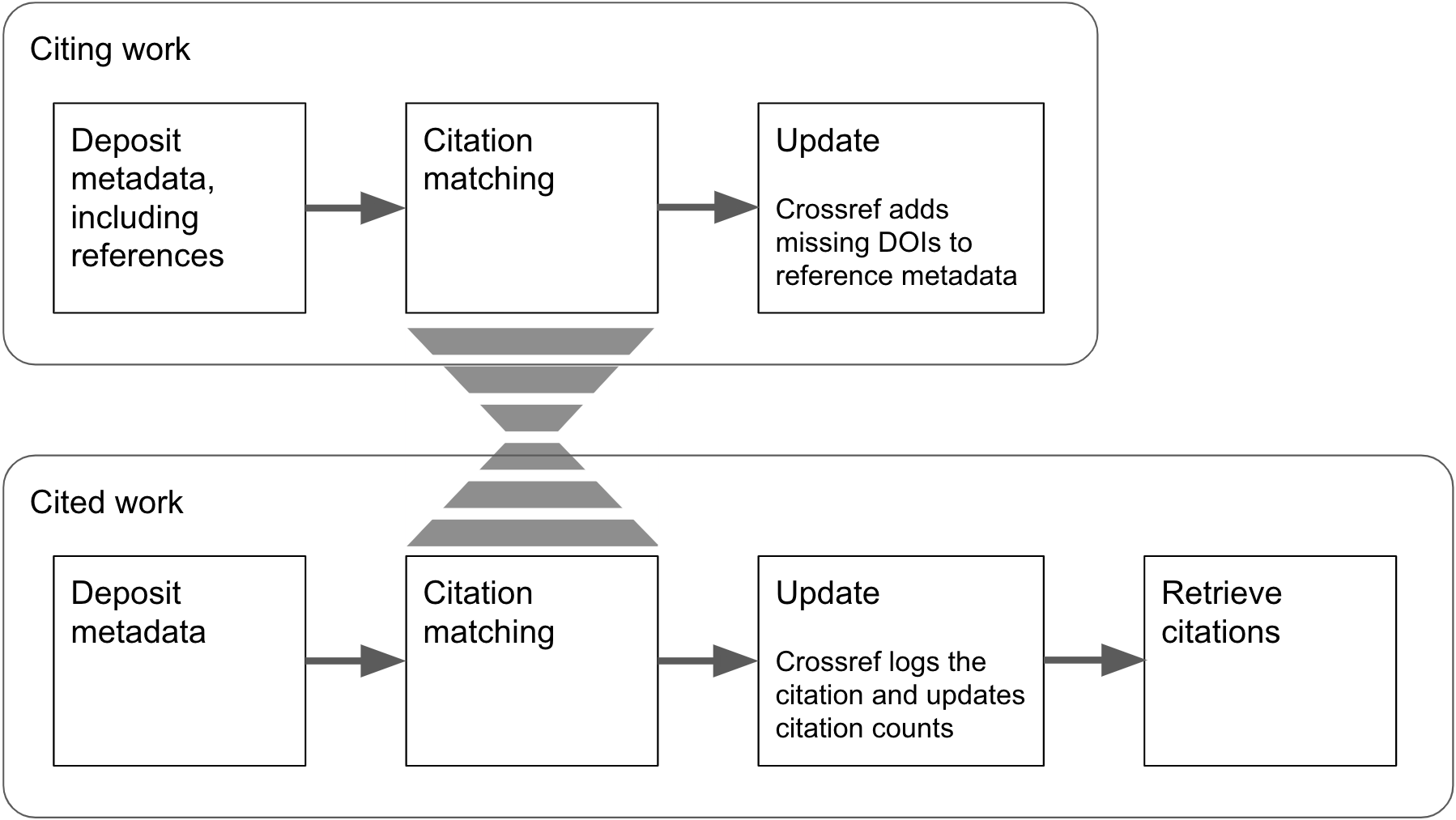
A member registers content for a work, the citing paper. This metadata deposit includes the reference list. Crossref automatically checks these references for matches to other registered content. If this is successful, a relationship between the two works is created. Crossref logs these relationships and updates the citation counts for each work. You can retrieve citation counts through our public APIs.
Members can use the Cited-by service to retrieve the full list of citing works, along with all the bibliographic details needed to display them on their website.
Note that citations from Crossref may differ from those provided by other services because we only look for links between Crossref-registered works and don’t share the same method to find matches.
Obligations and fees for Cited-by
Participation in Cited-by is optional, but encouraged.
There is no charge for Cited-by.
Depositing references is not a requirement, but strongly encouraged if you are using Cited-by.
Best practice for Cited-by
Because citations can happen at any time, Cited-by links must be kept up-to-date. Members should either check regularly for new citations or (if performing XML queries) set the alert attribute to true. This means the search will be saved in the system and you’ll get an alert when there is a new match.
Depositing your own references is strongly encouraged if you use Cited-by. If you don’t, the citations you retrieve will not include those from your own works. This is likely to lead to under-reporting of citations counts by at least 20% and you are missing the opportunity to point readers to other similar works on your platform.
Also in the metadata is the number of citations a work has received, under the tag "is-referenced-by-count".
To retrieve the full list of citations you need be a member using Cited-by. While anyone can use an API query to see the number of citations a work has received, members can retrieve a full list of citing DOIs and callback notifications informing them when one of their works has been cited. Details of the citing works can be displayed on your website alongside the article.
Page maintainer: Martyn Rittman Last updated: 2021-February-09