Each organization in the global community of Crossref members (that’s currently over 24k organizations in 166 different countries) plays a key role in building the Research Nexus. Any opportunity we have to meet with our members in person is a highlight and a way for us to learn more from each other. The month of January saw three of us travel to Bangkok to attend the first-ever Charleston Conference organised in Asia and to meet with our growing community in Thailand.
This year, we placed a spotlight on the Latin American community, hosting the second Crossref Metadata Sprint in São Paulo, Brazil from 4 - 6 March 2026. In our first tri-lingual event, we brought together 31 participants from Argentina, Brazil, Colombia, Ecuador, and Mexico. Our goal was to foster community co-creation using the open scholarly metadata. The Sprint was an opportunity to pose questions, share ideas, collaborate on research, and propose innovative solutions that enhance the use of metadata in scholarly communication and beyond.
Read on for more details about the content of the Sprint, and the resulting projects. You can also register to join our Sprint Showcase call on 22nd April to hear directly from the team about their creations.
On 17 March 2026, we experienced an outage that affected DOI resolution for Crossref DOIs and the deposit of metadata records by Crossref members. In this summary, we outline what happened, the impact on our community, and the steps we are taking to strengthen our systems and processes as a result.
We’re excited to announce a new data citation API endpoint and are seeking your feedback. The new service makes existing data citation relationships in our metadata available, thereby surfacing this part of the research nexus. At the same time, we’ve decided that it’s time to move on from Event Data.
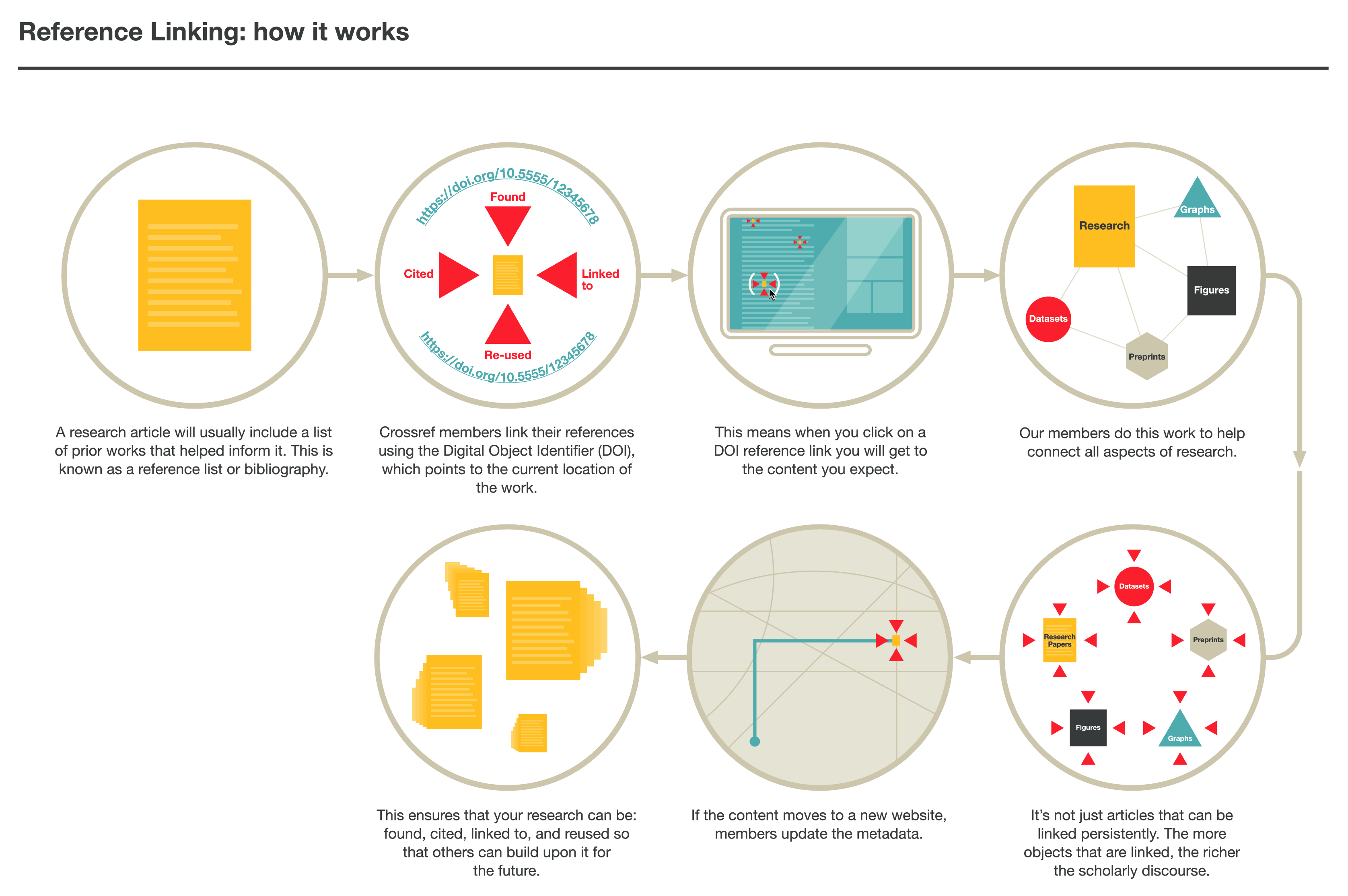
Reference linking enables researchers to follow a link from the reference list to other full-text documents, helping them to make connections and discover new things.
Reference Linking means including Crossref DOIs (displayed as URLs) in the reference lists that you provide in your own published work. This enables researchers to follow a link from a reference list to the current landing page for that referenced work. And because it’s a DOI rather than just a link, it will remain persistent.
So, instead of just including the reference in your reference list…
Soleimani N, Mohabati Mobarez A, Farhangi B. Cloning, expression and purification flagellar sheath adhesion of Helicobacter pylori in Escherichia coli host as a vaccination target. Clin Exp Vaccine Res. 2016 Jan;5(1):19-25.
…you should also display the DOI link:
Soleimani N, Mohabati Mobarez A, Farhangi B. Cloning, expression and purification flagellar sheath adhesion of Helicobacter pylori in Escherichia coli host as a vaccination target. Clin Exp Vaccine Res. 2016 Jan;5(1):19-25. https://0-doi-org.oasis.unisa.ac.za/10.7774/cevr.2016.5.1.19
Because Crossref is all about rallying the scholarly community to work together, reference linking is an obligation for all Crossref members. But you don’t have to be a Crossref member to link your references - we provide free tools that anyone can use to match their reference lists to existing DOIs so they can link their references.
Watch the introductory reference linking animation in your language:
Persistent links enhance scholarly communications. Reference linking offers important benefits:
Reciprocity: members’ records are linked together and more discoverable because all members link their references.
As a member organisation, we can obligate all our members to link their references, so that individual members can avoid the inconvenience of signing bilateral agreements to link to persistent resources on other platforms. The result is a scholarly communications infrastructure that enables the exchange of ideas and knowledge.
Discoverability: research travels further when everyone links their references. Because DOIs don’t break if implemented correctly, they will always lead readers to the resource they’re looking for, including yours. When the DOIs are displayed, anyone can copy and share them. This will also enable better tracking of where and when people are talking about and sharing scholarly objects, including in social media.
Obligations and fees for reference linking
Reference Linking is an obligation of membership for all Crossref members. But anyone can use our support tools for Reference Linking - you don’t have to be a member. And there’s no charge to use our support tools for Reference Linking.
Getting started with reference linking
There are various different ways to look up other member’s DOIs to add to your reference lists. Read more here.